

Getting the best color light for sleep can make a surprising difference to your nighttime routine. While bright blue and cool-white light can interfere with the body’s natural preparation for sleep, warmer colors such as red and amber light are generally better suited to the evening. But not every “warm” light is equally sleep-friendly, and the color temperature, brightness, timing, and wavelength all matter.
So, what is the best color light for sleep? In this guide, we’ll compare the most common light colors for nighttime use, explain how different wavelengths can affect your circadian rhythm and melatonin, and show you what to look for when choosing a sleep-friendly light bulb, bedside lamp, or bedroom lighting setup. Whether you want to improve your bedtime environment or simply avoid harsh light before bed, you’ll learn how to create a darker, warmer, and more sleep-friendly space.
Key Takeaways
- red or amber light—specifically between 590–660 nm—are the most sleep-compatible, based on biological evidence and low blue content. (MDPI review)
- Direct evidence for sleep quality is limited—most research comes from studies on skin and cellular responses, not randomized controlled sleep trials.
- Choosing a sleep light? Look for products that specify their wavelength (nm), avoid cool/blue-rich LEDs near bedtime, and prioritize safety for all users—especially children.
- Quick answer — which color light helps you sleep?
- How light color affects sleep — the biology in plain language
- Red vs. amber vs. warm vs. cool — what the (available) studies actually show
- Adults vs. children — what the evidence says and where it’s thin
- Practical, evidence-aligned usage rules (timing, intensity, distance, and device types)
- Safety, side effects, and common user complaints about LED sleep lights
- Gaps in popular coverage — the top 3 scientific/practical insights most articles miss
- Buyer’s checklist — what to look for when choosing a sleep light or bulb
- Quick reference summary + recommended settings for adults and children
- Frequently Asked Questions
Quick answer — which color light helps you sleep?

Based on current evidence, red or amber light in the long-wavelength spectrum (590–660 nm) is generally the best color light for sleep. This is because these wavelengths contain very little blue light—known to suppress melatonin and interfere with sleep timing. While direct sleep-improvement trials are limited, dozens of peer-reviewed studies in photobiomodulation show these wavelengths as biologically active and safe for evening use. According to an MDPI review, “Most studies focus on RL, NIR, and amber light (AL), a light of 590 nm close to red light,” highlighting why these ranges are referenced in best-practice guides for nighttime lighting (source).
How light color affects sleep — the biology in plain language
Our eyes and brains interpret light not only by brightness but by wavelength, measured in nanometers (nm). Blue and short-wavelength light (roughly 450–500 nm) signals daytime and powerfully suppresses melatonin, the hormone controlling natural sleepiness. In contrast, long-wavelength light (red and amber—about 590–660 nm) has little impact on melatonin, making it less likely to disrupt your sleep cycle.
The science: Most recent photobiomodulation (PBM) literature, including a 2024 J Am Acad Dermatol review (AAD), documents strong biological effects at 590 nm (amber) and 660 nm (red). While these studies target skin and cellular benefits, their findings confirm these wavelengths are active in human tissue and do not stimulate alertness like blue light does. This mechanistic link is why sleep experts and researchers extrapolate their safety and suitability for bedroom lighting, especially when compared to blue- or cool-white LEDs.
Read more about how blue light affects sleep.
Red vs. amber vs. warm vs. cool — what the (available) studies actually show
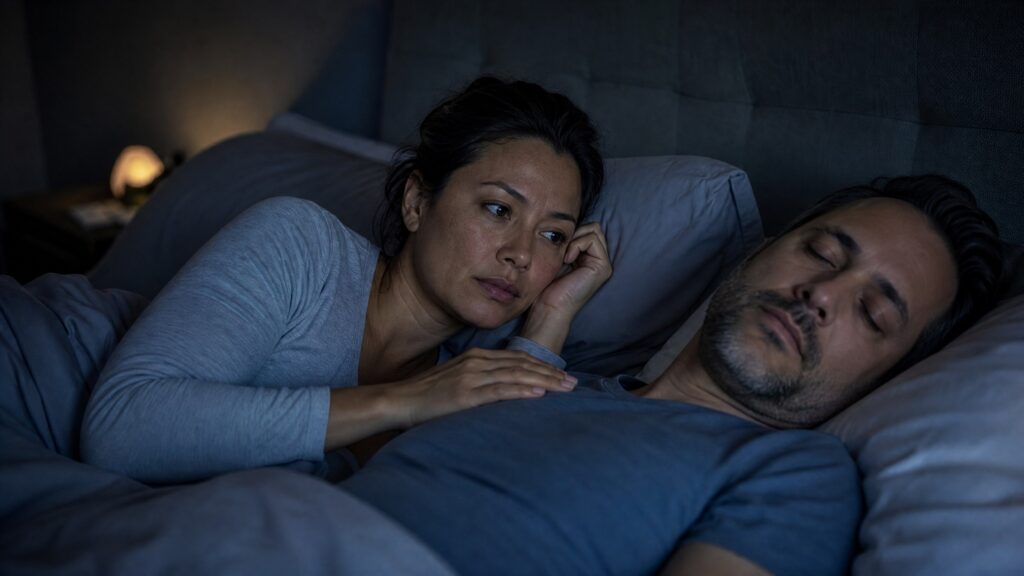
Let’s compare what’s truly known from the research on red light for sleep, amber light sleep, and LED color temperature for sleep.
| Light Color / Metric | Wavelength (nm) | Sleep Trial Evidence | Biological Activity (PBM) | Consumer Lighting Label |
|---|---|---|---|---|
| Red Light | 660 | Indirect (PBM, skin studies) | Strong (e.g., 30% wrinkle reduction, split-face trial PMID: 36780572) | Sometimes “night red” or “true red” |
| Amber Light | 590 | Indirect (PBM) | Strong (same trial as above) | “Amber” or “sunset” |
| Warm White | 2700-3000 (CCT) | Few direct sleep RCTs | Varies; may still emit blue | “Warm white” |
| Cool White / Blue-enriched | 4000-6500 (CCT), blue ~450–500 | Nocturnal use discouraged | Suppresses melatonin, strong alerting effect | “Cool white”, “daylight” |
Almost all studies demonstrating positive biological effects of light at night (photobiomodulation, including those for skin health) center on the 590–660 nm range. There are few, if any, peer-reviewed RCTs for sleep outcomes specifically using these wavelengths. “Warm” or “amber” labeling in consumer lighting is not regulated: the only way to guarantee biological compatibility is by checking the wavelength or seeing “low blue content.” For side-by-side practical reviews of LED and tunable home lighting for sleep, see options at Circadian Lighting: A Practical Guide to Better Sleep.
Adults vs. children — what the evidence says and where it’s thin
For adults, while the majority of the evidence for red or amber lights comes from skin, eye, and cell studies—not sleep-outcome RCTs—extrapolation is currently accepted in expert guidance. For children, caution is needed. There is a lack of sleep-specific pediatric data in the literature. Existing clinical updates (ConsumerLab) recommend consulting a pediatrician or dermatology specialist before using any novel light therapy device with kids, especially in populations with different sensitivities or underlying conditions.
Children’s developing eyes are more sensitive to both blue and intense light. Until direct sleep safety trials are available, low-intensity, long-wavelength (red/amber) lights—used briefly and never directed into the eyes—are the prudent choice, but consulting a pediatrician is a must.
See our take on picking child-safe circadian bulbs for more family-friendly tips.
Practical, evidence-aligned usage rules (timing, intensity, distance, and device types)
Here’s how to put the research into action at home. For evening and pre-sleep use, select long-wavelength (red or amber) bulbs with as little blue content as possible. Aim for a light intensity (lux) in the 30–300 lux range in the hour or two before sleep—ideally dimmed as bedtime approaches. Avoid cool or blue-enriched LEDs in the two hours before sleep. Warm color temperature (CCT) in lamps is better than cool, but CCT is an indirect metric—always verify by checking if the bulb is “amber”, “red”, and whether it specifies a wavelength (nm) around 590–660 nm.
Handheld and panel devices designed for photobiomodulation and sleep-friendly lamps should specify wavelength output. If shopping for a bedside or nursery lamp, seek dimmability, safety certifications, and avoid anything that appears bright white or blue-tinted in a dark room.
Explore the color metrics for circadian lighting here.
Safety, side effects, and common user complaints about LED sleep lights
While most adults use red or amber LEDs without major side effects, several user complaints appear in both product reviews and clinical advisories:
- Eye strain or discomfort—usually from lights that are too bright or directed at the eyes, even at “red” wavelengths.
- Ineffective results—typically related to bulbs using “warm white” LEDs that still have significant blue content.
- Flicker sensitivity—some cheap LED bulbs flicker at high frequency, causing headaches or sleep disruption.
- Color temperature mismatch—frustration with “warm” lights that look orange but still contain blue or lack sufficient dimming control.
Authoritative guidance from the American Academy of Dermatology and Cleveland Clinic (AAD, Cleveland Clinic) confirms red light therapy is generally low risk, but population-specific cautions remain, especially for those with darker skin or photosensitivity. Always monitor for discomfort—cease use if any irritation or abnormal symptoms appear.
For more on device pitfalls and lighting mistakes, see the 10,000 Lux Light Therapy Buying Guide.
Gaps in popular coverage — the top 3 scientific/practical insights most articles miss
- Wavelength specificity matters: Most advice is vague (“use warm light”) but the literature is clear—devices emitting in the 590 nm (amber) and 660 nm (red) range are most biologically aligned, while CCT alone is unreliable. (source)
- Timing and intensity are as important as color: Even red or amber light in excessive intensity can become alerting; aim for 30–300 lux in the 1–2 hours before bed.
- Few direct sleep RCTs exist, especially for kids: Most recommendations draw from photobiomodulation and circadian biology, not randomized sleep trials—always apply expert discretion, particularly for children’s use.
Learn why smart home lighting creates better routines in our Alexa guide for circadian lighting.
Buyer’s checklist — what to look for when choosing a sleep light or bulb
- Wavelength (nm): Prefer devices that specify emission near 590 nm (amber) or 660 nm (red).
- Color Temperature (CCT): Choose 2000–2700 K for warmer light, but verify for blue content.
- “True” Red/Amber LEDs: Avoid “warm white” marketing without blue-blocking credentials.
- Dimmability: Adjustable brightness is essential for reducing late-evening stimulation.
- Minimum Lux: Aim for bulbs that allow dimming down to 10–50 lux at the pillow or bedside.
- Certifications: Check for eye safety and electrical certifications (e.g., UL, CE).
Our recent review of Philips Hue circadian bulbs covers specs, safety, and where to buy for the best deals.
Quick reference summary + recommended settings for adults and children
For most adults, long-wavelength red or amber light (590–660 nm) at low intensity (30–150 lux) is the safest bet in the last 1–2 hours before bedtime. Limit screen or blue-enriched exposure, dim all main room lights, and use task or bedside lamps that specify either their wavelength (nm) or advertise “no blue content.” For children, use the same guidelines, but always consult a pediatrician before installing or testing new sleep lighting—there are no high-quality sleep studies in this group yet.

Bottom line: Red and amber LEDs dominate the biological literature, and while direct sleep RCTs are lacking, their safety and suitability justify their use as the best color light for sleep for most modern households.
Conclusion
To maximize restful nights, focus on lighting with wavelengths between 590–660 nm—red or amber—especially in the crucial 1–2 hours before sleep. This advice arises from careful review of the wider photobiomodulation literature and consumer mishaps, not just marketing claims. When selecting your sleep bulb or lamp, always scrutinize for wavelength, intensity range, and strong product certifications. With these steps, you elevate your sleep hygiene the evidence-based way. Ready to upgrade your sleep environment? Choose your next LED with confidence and revisit our full guides for deeper dives.
Frequently Asked Questions
What is the safest color light for children’s bedrooms?
safest color light (590–660 nm) at low intensity is safest, but always consult your pediatrician before introducing new lights. Never use white or blue light near sleep time for kids.
Can I use regular “warm white” LED bulbs for sleep?
Regular warm white bulbs (2700–3000 K) can still emit significant blue light. For optimal results, use bulbs that specifically state their emission wavelength as 590 or 660 nm, or that are labeled “no blue content.”
How close should a sleep light be to the bed?
Keep the lamp at least 2–4 feet away from your pillow, angled away from direct line of sight. Focus on achieving a comfortable, low lux (less than 100) at head level.
Are there side effects to using red or amber LEDs for sleep?
Most users experience no side effects with low-intensity red or amber LEDs. Some may have eye sensitivity or discomfort if the light is too bright or flickers. Always stop use if irritation occurs.
Where can I find science-backed circadian lighting products?
Choose brands that label actual wavelengths and offer real dimming. Check out our resources on smart bulb buying for detailed product comparisons.