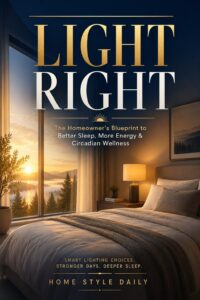


Circadian rhythm lighting uses the timing, intensity, and color of light to support the body’s natural sleep-wake cycle. This article explains how lighting influences circadian rhythms, why bright or blue-rich light can affect evening alertness, and how adjustable lighting can help create a more sleep-friendly environment. It also covers practical considerations for using circadian lighting at home, including daytime brightness, evening light levels, and bedroom lighting choices.
Key Takeaways
- Circadian lighting automates changes in color and intensity so your environment supports your body clock—boosting morning focus and evening winding down.
- Clinical studies confirm that light (especially specific wavelengths and precise timing) can cause real biological effects, but most dramatic skin and hair claims come from targeted photobiomodulation, not ambient home lighting.
- Buying the right system means checking technical specs and avoiding products that promise medical outcomes without robust scientific evidence.
- What is circadian lighting?
- How circadian lighting works — the biology in simple terms
- Evidence summary (2022–2024): what the science shows and what’s missing
- What light-therapy studies say (and why they are NOT the same as home circadian lighting)
- Key benefits of circadian lighting for everyday users (what’s supported vs. speculative)
- Most common installation and user challenges at home
- Choosing the right system — technical metrics and shopping checklist
- Practical home schedule and quick implementation guide
- Limitations, safety and common myths
- Use-cases and who benefits most (and who should be cautious)
- Short FAQ — 8 fast answers beginners ask
- Further reading and credible resources
What is circadian lighting?
Wondering what is circadian lighting? Imagine lighting that changes on a schedule—brighter and “bluer” in the morning, softer and “warmer” at night—designed specifically to “nudge” your body clock into a healthier rhythm. Circadian lighting is about syncing home or office lights to the natural signals your brain expects: more intensity and blue-enriched light when you want to be alert, less and warmer light as you prepare for sleep. Crucially, circadian lighting is distinct from medical light therapy devices that aim to treat conditions like seasonal affective disorder or use red/amber wavelengths for skin treatments—those involve precisely tuned wavelengths and doses for clinical outcomes.
Many people don’t realize that light doesn’t just help us see—it affects our biology. Recent research (Maghfour et al., J Am Acad Dermatol, 2024) shows different wavelengths produce measurable effects on our bodies. This “biological lighting” science is why designers, health experts, and tech companies are now focused on what type of light, when, and how much you’re exposed to each day.
How circadian lighting works — the biology in simple terms
When light enters your eyes—especially the blue-enriched light of morning—it’s detected by special cells called ipRGCs (intrinsically photosensitive retinal ganglion cells). These cells act as your body’s light sensors, triggering a cascade: light signals the brain’s “master clock” (the suprachiasmatic nucleus), which then shifts the timing of melatonin production. Bright light early in the day = more alertness, later/dimmer light = easier sleep. It’s not just the light color that matters—timing and intensity together drive these biological shifts.
The take-home: Light tells your body when to be awake or asleep. That’s why simply using color-changing bulbs without automating the schedule often doesn’t deliver results. Most health benefits in clinical trials depend on exposing subjects to the right intensity and color for the right amount of time—sometimes as little as 10–12 minutes for specific effects (see research).
Want to go deeper? You can learn more about light and sleep here.
Evidence summary (2022–2024): what the science shows and what’s missing
Here’s the bottom line on evidence: Light does affect biological processes, and recent reviews like Maghfour et al. (J Am Acad Dermatol, 2024) show clear clinical responses in skin, hair, and wound healing—BUT nearly all this research uses high-powered, wavelength-specific (usually red, NIR, or amber) lights for photobiomodulation, not ambient home fixtures.
Clinical trial data from 2023–2024 demonstrate measurable improvements in skin appearance: for instance, a 2023 human trial found a 38.3% reduction in wrinkle depth after 12 weeks of red light therapy, and another showed up to 36% wrinkle reduction and 19% boost in skin elasticity with regular use (see source).
However, ONLY a few small studies specifically examine “circadian-tuned ambient lighting” in real homes for generalized sleep or mood improvements, often with mixed or limited results. Most “circadian lighting benefits” promoted by brands are based on the basic principles of biological lighting—not on large, long-term RCTs conducted in everyday residential settings yet.
What light-therapy studies say (and why they are NOT the same as home circadian lighting)
Many product claims borrow stats from red/amber/NIR light therapy research—but here’s the catch: these clinical protocols use focused, skin-contact devices (think LED mask, light panel) with strictly controlled doses and wavelengths. Results include faster wound healing, hair regrowth, and striking improvements in wrinkles and skin quality (see review). For example, clinical findings include up to a 38.3% reduction in wrinkle depth and a 19% increase in skin elasticity after 12 weeks of twice-weekly sessions. Most protocols use 10–12 minutes per session, twice weekly, under direct LED exposure—completely different from general circadian/ambient bulbs placed overhead.
So, while human centric lighting definition often includes claims about mood or alertness, don’t confuse photobiomodulation therapy devices (medical, FDA-regulated) with the tunable fixtures you install at home. For deeper clinical device info, see the 10,000 Lux Light Therapy Buying Guide.
Key benefits of circadian lighting for everyday users (what’s supported vs. speculative)
Here’s what ordinary users—especially remote workers or parents like Sarah—stand to gain from body clock lighting:
- More consistent sleep-wake timing. By shifting light intensity and color as your day unfolds, you support natural melatonin rhythms. This can help you feel tired at bedtime and more awake in the morning (see practical guide).
- Daytime focus & alertness. Exposure to dynamic, bright light in the morning (not just “blue light” but overall brightness) can help you avoid morning grogginess and maintain energy levels through remote work or busy parenting.
- Improved mood/productivity. There’s quality evidence that lighting impacts mood—especially in offices and senior facilities—though most personal home studies are small or short-term as of 2024.
It’s important to be clear: claims about skin rejuvenation, wound healing, or hair regrowth are not produced by ordinary ambient home bulbs. These require targeted clinical photobiomodulation therapy—specific spectrum, exposure, and device, as shown in the studies above. If those goals are top priority, consider clinical devices; don’t expect them from your kitchen fixtures.
For more details, see our Philips Hue circadian bulb buying guide.
Most common installation and user challenges at home
Reality check: setting up “circadian rhythm lighting” is not always plug-and-play. Here are the main stumbling blocks:
- Compatibility: Bulbs may need Philips Hue or Matter/Thread hubs. Not all smart fixtures work with all platforms (bridge-free setup options).
- Confusing product claims and metrics: Terms like “tunable white,” “body clock lighting,” “melanopic lux,” “CRI”—few brands publish clear spectral charts or evidence-backed circadian impact scores.
- Complex setup/scheduling: App routines are often buried; automating by time of day isn’t always intuitive. See step-by-step Alexa circadian lighting routines.
- Retrofit and cost limits: Replacing every bulb or installing smart switches can add up. Some rooms (like kitchens with fluorescence or vintage fixtures) resist easy upgrades.
- Therapy vs. tunable lighting confusion: Many users conflate clinical “10–12 min twice weekly” protocols from LED therapy research with ongoing, whole-house ambient tuning—these are not remotely the same.
Want to understand which color metric matters most for circadian lighting? See circadian color metrics explained.
Choosing the right system — technical metrics and shopping checklist
Shopping smart means looking beyond marketing names. Here’s exactly what matters:
- Tunable CCT (correlated color temperature)—ideally can automate from 2200K (very warm) up to 6500K (cool daylight).
- Controllable intensity—brightness must change, not just color.
- Melanopic lux or EML metrics—rare but ideal; shows true “biological” impact.*
- Spectral data—look for real, manufacturer-supplied spectral graphs summarizing output; spectrum matters far more than “color name.” Clinical research focuses on RL (red light), NIR (near-infrared), and amber (590 nm)—not the full rainbow.
- Smart-home integration—works with Alexa, HomeKit, Google, especially via open APIs or Matter-protocol for easy future-proofing.
- Warranty and certification—favor brands that are transparent with claims and have at least 2–3 year warranties.
- Automated schedule support (or open API for routines)
- Full spectrum (warm and cool) CCT range
- Clear brightness/intensity control (not just color shift)
- Spectrum or EML/MLux rating published
- No medical or therapeutic claims without references
Practical home schedule and quick implementation guide
Here’s an actionable plan for a 24-hour circadian lighting routine at home:

- Morning (wake up): Bright, blue-enriched light at/above eye level. Use 5000–6500K for home offices and kitchens. Automate lights to match weekday wake-up, 20–60 minutes as you get moving.
- Mid-day: Neutral/cool white light, moderate brightness. No big midday color shifts needed—just keep lights “daylight balanced” for sustained energy.
- Evening (after sunset): Gradually dim and shift color to 2200–2700K (very warm/amber). Use lamps or indirect light—overhead “spotlights” make it too easy to stay alert late.
- Bedrooms: Use motion triggers or voice controls to ensure late-night lights don’t default to bright/cool settings; ideally, install bulbs or smart plugs that can’t be left in “day” mode by accident.

You can automate this using any smart-home system or just set calendar reminders to adjust lights. As in light therapy research, timing and routine matter: many clinical benefits come from consistent, short exposures each day—not random color changes or occasional use.
- Install at least one tunable bulb in your bedroom and your main living/working space.
- Use app automations to ramp up brightness/CCT at your wake-up (e.g. from 2200K/10% to 6000K/100%) and ramp down after sunset.
- Track your sleep onset/wake quality for two weeks before and after—note energy, focus, or changes in family sleep.
- Adjust intensity/color based on mood and feedback. Results are usually visible in 1–2 weeks; continue for a month for best insights.
Limitations, safety and common myths
Safety: Circadian lighting systems use low-intensity, eye-safe LEDs. Unlike photobiomodulation therapy devices, they’re not designed to treat medical conditions and generally don’t require special safety precautions for healthy people.
Limitations & Myths: Be wary of any bulb or home lighting system claiming to “cure” insomnia, eradicate depression, or produce anti-aging skin results. These claims are based on targeted light-therapy research—usually with controlled, medical-grade equipment. For true sleep or dermatological treatment, consult a doctor and consider clinical devices, ideally guided by protocols summarized in the Maghfour et al. 2024 review.
Ambient circadian lighting can support better sleep and mood, but it is not a substitute for clinical care where needed.
Use-cases and who benefits most (and who should be cautious)
Circadian or body clock lighting makes the biggest difference for:
- Shift workers resetting after nights or rotating schedules
- Remote workers (like Sarah) who miss morning sun/light cues
- Elderly in memory care or those at high risk of sleep disturbances
- Families wanting better sleep for kids, especially around school times
Users with photosensitivity, some eye disorders, or serious sleep/mental health issues should always consult a professional before changing light significantly. As shown in light therapy studies, targeted interventions can have potent effects but are not always appropriate for every user or condition.
Example: Sarah, 35, uses Alexa routines for automatic color shift and avoids skin-care LED hype. Within 3 weeks, her son’s bedtime became 30 minutes easier—plus her own focus improved on remote workdays. But for a friend with psoriasis, medical phototherapy is still needed—circadian lighting alone would never replace it.
Short FAQ — 8 fast answers beginners ask
Does circadian lighting cure insomnia?
No. Circadian lighting can support regular sleep-wake cycles but does not replace medical treatment for clinical insomnia. Large-scale studies on “cures” do not exist for ambient home systems.
Is blue light always bad?
No. Blue-enriched light in the morning supports alertness and regulates your body clock. It becomes disruptive only at night, when it delays melatonin and makes sleep harder—see our guide for details.
Can I retrofit existing fixtures?
Often yes. Many smart bulbs (Philips Hue, LIFX, Matter-compatible) can replace standard bulbs. Complex fixtures may need a switch swap or a bridge—see bridge-free circadian lighting for full details.
How much does it cost?
Basic single-room setups start around $25–40. Full home, multi-bulb routines (with smart switches/hubs) run $200–600+. High-end, tunable fixture systems are more.
How soon will I see changes?
If you automate morning/evening cycles, most people notice shifts in energy or sleep within 5–14 days of consistent use—just as clinical light therapy protocols define improvements within a few weeks.
Do I need an app or smart hub?
Many tunable bulbs work with phone apps, Alexa, or Google without a hub. Larger installations benefit from Matter/Thread or a dedicated hub for reliable, house-wide scheduling.
Can body clock lighting fix mood or depression?
It may help mild cases and support overall routine, but clinical trials use much higher dosed, medical devices (see 10,000 lux therapy guide). Don’t replace mental health care with ambient lighting alone.
Are red, amber, or NIR bulbs better for skin?
For skin benefits, clinical studies use powerful, close-proximity LEDs, not color-tunable home bulbs. The anti-wrinkle effects cited are from medical photobiomodulation—not general body clock lighting.
Further reading and credible resources
- Photobiomodulation review: Maghfour et al., 2024, J Am Acad Dermatol
- Clinical study: 38.3% wrinkle reduction after 12 weeks of RLT
- Alexa routines for circadian lighting
- 10,000 Lux Light Therapy Buying Guide
- Search for recent “circadian lighting RCT” or “biological lighting randomized controlled trial” for studies after 2024.
For comprehensive, practical advice about tuning your home, see our Circadian Lighting Practical Guide.
—