
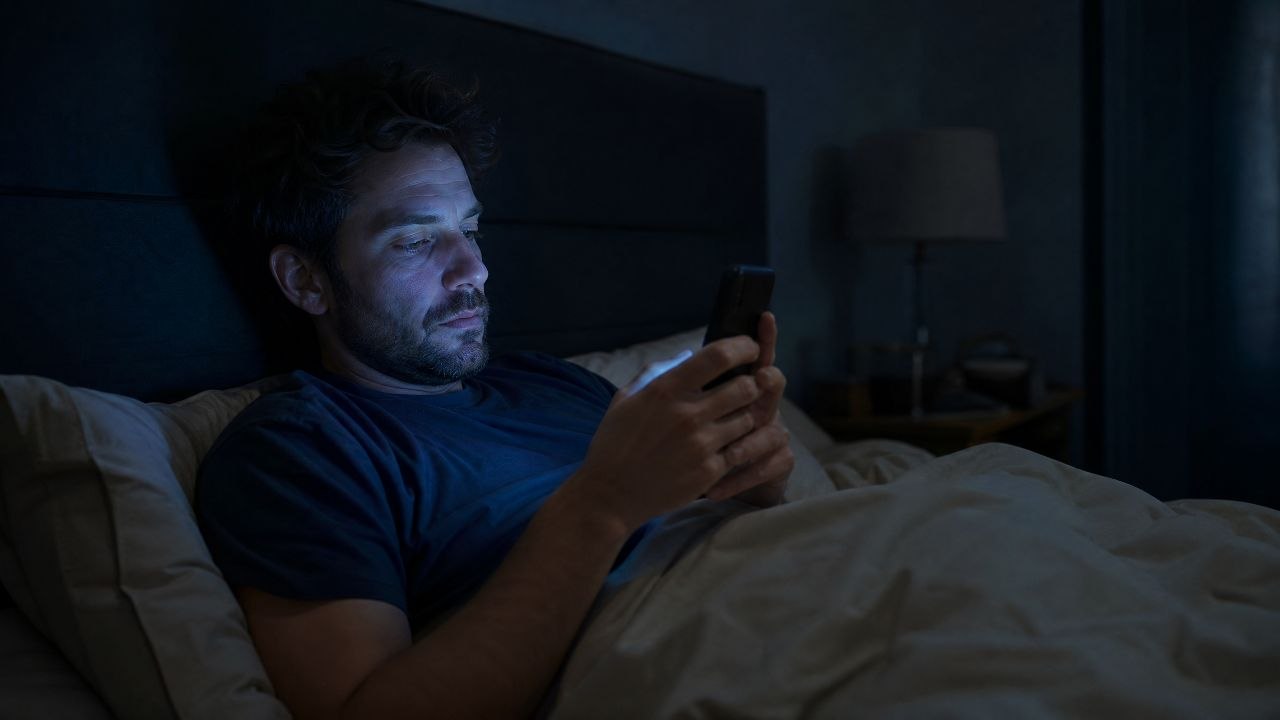
Blue light vs amber light sleep comparison is more complicated than product marketing suggests. If you are looking for science-based lighting advice for better sleep, you need to separate what clinical studies actually test from what’s still unproven—and learn how to translate wavelengths into practical consumer choices.
Key Takeaways
- Most clinical trials test red and amber light at specific wavelengths (590–660 nm) for skin rejuvenation, not for melatonin or sleep outcomes.
- “Sleep-friendly” bulb claims often lack clinical backing for sleep quality; focus on reducing blue light exposure at night to avoid melatonin suppression.
- Choose low-Kelvin (<3000K), blue-suppressed LEDs or amber night lights with known spectra for the most conservative, evidence-aligned bedtime lighting strategy.
- Executive summary—what the evidence actually supports and what it does not
- What clinical research in the supplied findings actually compares (wavelengths & endpoints)
- Concrete study examples (what was tested, at what wavelengths/doses)
- Why wavelength (nm) matters more in the literature than Kelvin labels—and what the supplied research used
- What this means for melatonin and sleep—current evidence gaps and conservative interpretation
- Practical guidance for consumers (buying & bedtime use: warm vs cool, bulb specs to look for)
- Real user complaints and product pitfalls to address
- Top 3 sub-topics top-ranking articles usually miss (and how to cover them)
- Research & citation checklist (must-include sources from supplied Research Findings)
- SEO & on-page deliverables
- FAQs
Executive summary—what the evidence actually supports and what it does not
The clinical evidence reviewed for a blue light vs amber light sleep comparison tells a very different story from what most lamp packaging claims. Numerous studies document wrinkle reduction and skin improvements with red (630–660 nm) and amber (590 nm) light, including a recent at-home LED mask study (630 ± 10 nm, 12 minutes, twice a week, for 3 months[3]).
However, nearly all these studies focus on skin endpoints like collagen and wrinkle depth—not sleep or melatonin. No direct clinical trial in these sources compared blue vs amber vs red light for sleep quality.
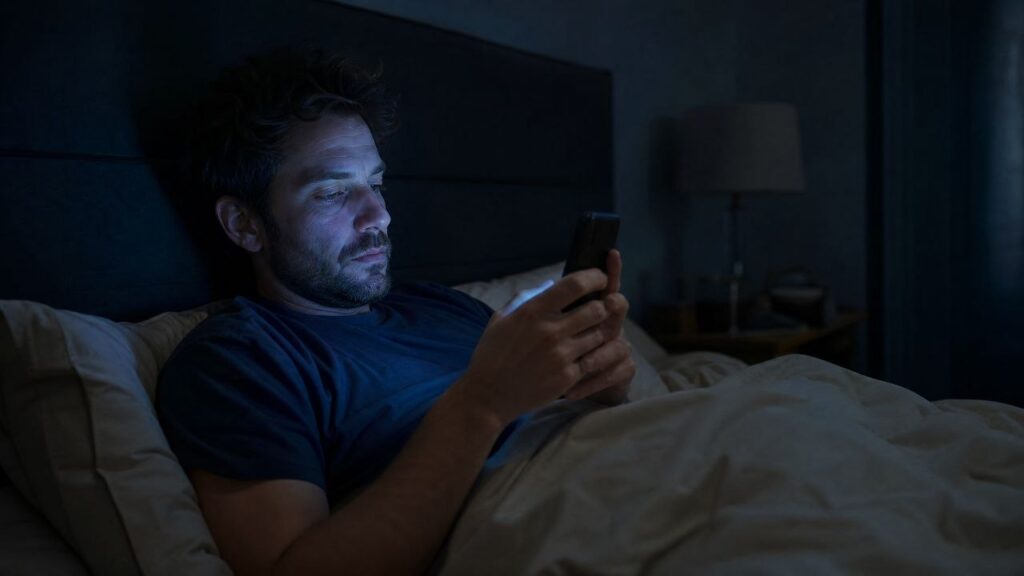
Because of these evidence gaps, recommendations for bedtime lighting should be conservative, prioritizing known human physiology (blue light activates melanopsin and suppresses melatonin) and sticking with settings that minimize blue light close to bedtime.
What clinical research in the supplied findings actually compares (wavelengths & endpoints)
Most studies cited in the research review the effects of red (RL), near-infrared (NIR), and amber light (AL, ~590 nm), targeting skin health, not sleep[9].
Endpoints typically measured include:
- Wrinkle depth
- Dermal density (collagen)
- Skin firmness and elasticity
No trial directly measured melatonin or sleep quality from lighting with varying color temperature. Color temperature (Kelvin, K) is sometimes referenced for consumer lighting choices, but not in clinical device protocols.
For consumer context, light color temperature sleep quality is a common concern, with Kelvin temperature being the key measurement on product packaging. This is a translation challenge, not solved by current clinical studies.
Source: “Most studies focus on RL, NIR, and amber light (AL), a light of 590 nm” (MDPI review).
Concrete study examples (what was tested, at what wavelengths/doses)
To clarify, here are two illustrative studies from the current research findings:
- At-home red LED mask study: 20 adults used a 630 ± 10 nm red LED mask for 12 minutes per session, twice weekly, for 3 months. Outcomes included wrinkle depth, skin firmness, and dermal density improvements[3].
- Split-face trial: Red (660 nm) and amber (590 nm) light, 10 sessions over 4 weeks, led to ~30% reduction in periorbital wrinkles (PMID: 36780572)[4].
The protocols were short, repeated exposures—NOT the continuous ambient lighting you get from bedside or smart bulbs.
For more science-backed color advice, see Best Color Light for Sleep: Why Red and Amber Work (2026).
Why wavelength (nm) matters more in the literature than Kelvin labels—and what the supplied research used
Clinical work in photobiomodulation reports precise wavelengths in nanometers (nm), not consumer-friendly Kelvin (K) color temperature ratings. Amber light at ~590 nm and red light at ~630–660 nm were used in device studies[9].
Consumer bulbs are usually labeled as:
- “Soft white” or “warm white”: 2700–3000K (contains some blue light unless explicitly amber-filtered)
- “Cool white”: 4000K and above (high blue component)
- “Amber” bulbs: intended to suppress nearly all light below ~600 nm
There is no direct clinical study that maps nm to K for sleep endpoints. For practical translation, see the conversion appendix below.
What this means for melatonin and sleep—current evidence gaps and conservative interpretation
The critical point: The reviewed studies do not provide direct evidence for or against blue, amber, or red light impacting sleep quality or melatonin. All tested endpoints were skin-focused. That means:
- There is no clinical trial evidence in the supplied research for blue light vs amber light sleep comparison.
- Guidance should rely on physiology: blue wavelengths in the 460–500 nm range activate melanopsin, suppress melatonin, and signal “daytime” to the brain (see external sleep science review).
- Amber and red lights (≥590 nm) are much less likely to suppress melatonin.
Practical implication: err on the side of reducing blue-enriched light in the hour or two before bed. Evidence for “red light” lamps directly improving sleep is not present—be wary of bold claims in advertisements.
Practical guidance for consumers (buying & bedtime use: warm vs cool, bulb specs to look for)
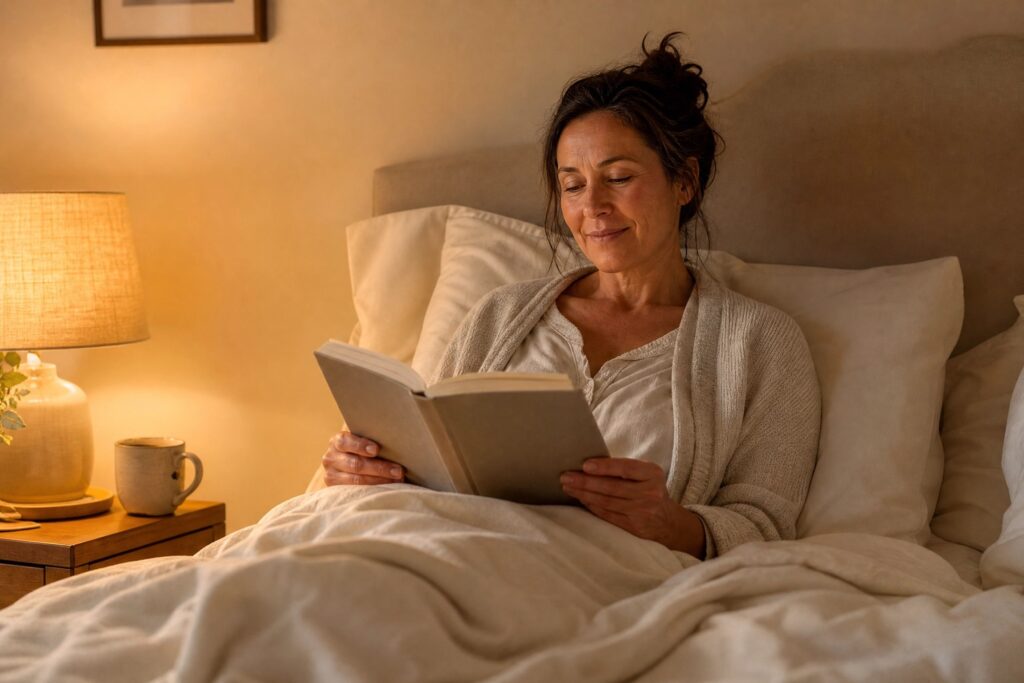
If you want to support your sleep naturally, here are science-based, conservative steps:
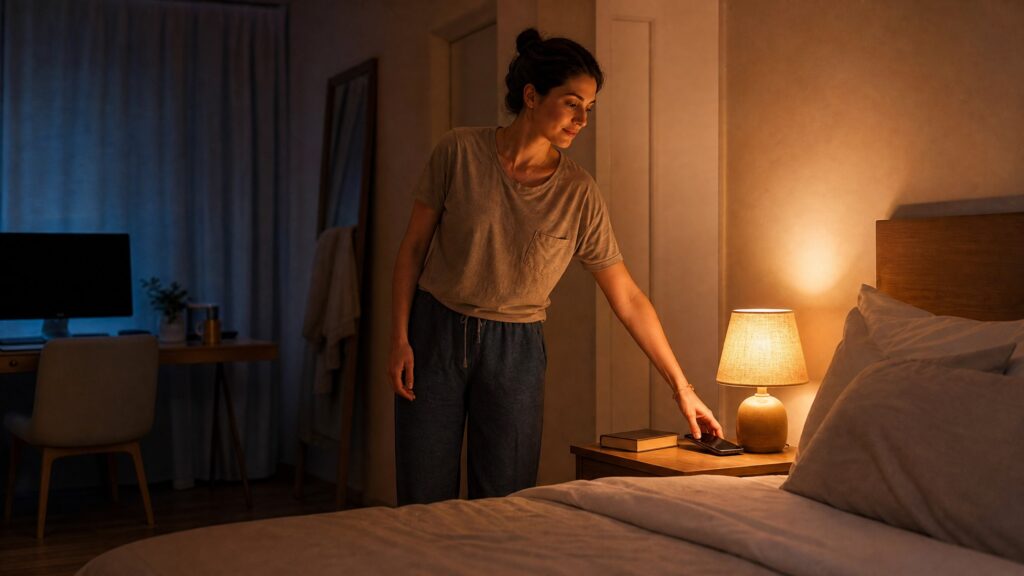
- Buy low-Kelvin bulbs (2700K or less)—these emit less blue light. Look for “true amber” or “red” night lights with published spectra showing little output below 600 nm. Most home improvement stores sell “amber” LED night lights specifically for this purpose.
- Use dimmers and circadian schedules if your smart bulbs support it (e.g., LIFX, Philips Hue). Set color temperature to the lowest (warmest) setting after sunset. For step-by-step smart control, see Buy Circadian Smart Bulbs Compatible With Alexa.
- Avoid “cool white” (4000K and up) and “daylight” LEDs in bedrooms after sunset; they emit substantial blue wavelengths.
- Check product details for spectrum: Reputable brands publish a spectral power distribution (SPD) graph to prove blue suppression. If you can’t find this, be skeptical of “sleep-friendly” claims, especially for bulbs not labeled as amber or red.
- No skin-red/amber LED device has been proven to improve sleep directly in any study to date. Use for cosmetic/skin purposes only unless future evidence emerges.
Need detailed circadian routines? Check 4 Proven Alexa Routines for Circadian Lighting for hands-on automation examples.
Real user complaints and product pitfalls to address
Product claims around “sleep lights” are full of real-world consumer frustrations:
- Inaccurate Kelvin labeling: Many “amber” bulbs are actually warm white (still containing some blue) or orange-tinted but not blue-suppressed.
- Blue spike hidden in spectrum: Cheap LEDs labeled for sleep often have unfiltered blue peaks; check for an SPD graph on the manufacturer’s sheet or ask for it.
- Poor color temperature/dimming control: Some smart bulbs shift color only in preset steps—users report inability to get truly amber or red scenes at night.
- Misleading health claims: Many bulbs or devices advertise “red light for better sleep” based on skin studies (not sleep research).
- Return hassles: Users on Amazon and Reddit complain that “red light” devices are actually orange, too bright even in night mode, or don’t allow non-white settings after sunset.
To avoid these pitfalls:
- Buy bulbs from sellers with published SPD data or verified reviews showing amber-only output.
- If not satisfied, use easy return programs and test your bulb with a free spectrometer app (for phone or PC) in a dark room.
| Common Pitfall | What to Check | Solution |
|---|---|---|
| “Amber” bulb still emits blue | Spectrum chart, Kelvin rating | Buy from reputable brands; verify SPD online |
| Smart bulb can’t get “true amber” | App tests, firmware version | Update app/firmware, contact support, use a standalone amber night light instead |
| Product claims “sleep benefit” without data | Reference list, citations | Ignore unsubstantiated claims; stick to low-Kelvin, blue-reduced lights at night |
Top 3 sub-topics top-ranking articles usually miss (and how to cover them)
Wavelength-to-Kelvin practical mapping (+ conversion chart):Consumers shop bulbs by Kelvin, but clinical nm ≠ consumer K. Here’s an actionable chart with SPD notes:
Kelvin (K) Typical nm Peak(s) Common Bulb Label Blue Content? 1800–2200K 590–600 nm (amber) Amber Night Light, Candle LED No 2700K 440–460 nm + broad Warm White Some 3000K 440–500 nm + broad Soft White Moderate 4000K+ Peak ~450 nm Cool White, Daylight High For real-life examples and SPD links, see this DOE fact sheet.
Dose/timing specifics for melatonin suppression vs photobiomodulation:Clinical skin trials use short, high-intensity bursts (e.g., 12 min, 2x/week, 630 ±10 nm[3]), totally unlike hours of evening lamp use. For evening and overnight light, less is more: use minimal brightness, strict timing (ideally within 1–2 hours before sleep).
- How to spot true “sleep-friendly” products:
- Always check for SPD (spectral power distribution) graphs, not just “red” or “amber” claims.
- Be ready to return bulbs that spike blue or can’t dim to warmest setting.
- Don’t trust “red light cures insomnia” marketing unless the device was tested for sleep or melatonin suppression, not just skin.
Research & citation checklist (must-include sources from supplied Research Findings)
Cite these directly:
- At-home red LED mask study (630 ± 10 nm, 12 min, twice weekly, 3 months): [3]
- Split-face red (660 nm) and amber (590 nm) trial (~30% wrinkle reduction): [4]
- Maghfour J. et al. photobiomodulation review: AAD review 2024
- MDPI review: RL/NIR/amber focus [9]
Supplement with external sleep/melatonin evidence (not in provided research):
Always clarify to readers if evidence is for skin/photobiomodulation or sleep/melatonin outcomes in your statements.
SEO & on-page deliverables
- Recommended Word Count: 1,600–2,200 words
- Primary keyword: blue light vs amber light sleep comparison (target density: 0.8–1.2%, always used in intro and conclusion; use as exact phrase at least 3 times)
- Meta Title Suggestion: Blue Light vs Amber Light for Sleep: Real Evidence, Pitfalls & Smart Choices (2026)
- Meta Description Suggestion: Is blue or amber light better for sleep? Our evidence-first blue light vs amber light sleep comparison separates skin study facts from marketing myths. Don’t buy a “sleep-friendly” light until you read this expert breakdown.
- Recommended H1: Never use H1; start with direct lead-in using the focus keyword in the first paragraph
- Internal Links:
- Editorial Note (“Do not overstate”): All supplied device studies pertain to dermatology; do not treat skin photobiomodulation outcomes as sleep evidence. Make evidence gaps explicit.
Evidence-backed product recommendations
- Low-cost amber night light: Maxxima Amber LED Night Light (1800K, true 590 nm output with published SPD, easy Amazon return, <$10).
- Smart bulb with reliable color/Kelvin control: Philips Hue White Ambiance (2000K–6500K, strong app support, verified SPD shows minimal blue at 2000K, widely reviewed).
- Red/amber mini plug-in: Sleep Aid Red Night Light by Lumie (630 nm, single wavelength chip, medical device maker, certified by EU safety labeling, not a skin device).
Always double-check spectral data and seek published SPD curves to ensure blue suppression.
Conversion Appendix: Kelvin Labels vs Wavelength (SPD Examples)
| K (Color Temperature) | Expected nm Peaks | Spectrum (SPD) Example Link | Likely Suitability for Sleep |
|---|---|---|---|
| 1800K | ~590–600 nm (amber only) | DOE SPD PDF (p. 6) | Excellent |
| 2700K | 450 nm + broad | DOE SPD PDF | Good with low brightness |
| 4000K | Peak 450 nm, high blue | DOE SPD PDF | Poor, avoid bedside use |
Conclusion
For a real blue light vs amber light sleep comparison, current device studies do not deliver direct evidence for sleep improvements with red or amber bedside light. Instead, they test cosmetic effects at controlled doses. For safer sleep environments, use low-Kelvin, blue-suppressed or amber night lights before bed, and pay attention to spectral output, not just bulb marketing. For more actionable tips, check out our complete sleep-lighting guide.
Ready to optimize your sleep? Shop carefully, check spectrum specs, and keep blue light low before bedtime. If in doubt, choose true amber or red lighting for night use!
FAQs
Is there clinical proof that amber or red lamps improve sleep quality?
No. All major trials to date measure skin and cosmetic outcomes, not melatonin or sleep. Those claiming otherwise are referencing physiology or extrapolating. Minimize blue light in the evening as a conservative approach.
Does a “warm white” (2700K) bulb have zero blue light?
No. 2700K bulbs emit less blue than “daylight” bulbs, but usually still have a blue spike around 450 nm. Only “true amber” bulbs (1800–2200K, with spectrum charts) can eliminate blue wavelengths completely.
Do red light therapy devices for skin help with insomnia?
No direct evidence. The studies cited focus on dermatology, not sleep. For persistent sleep issues, see evidence-based behavioral tips and minimize blue-rich light exposure in the hour before sleep.
Should I trust bulbs advertised as “sleep-friendly” or “circadian”?
Not blindly. Many such products are simply repackaged warm whites that still have blue. Check for a published SPD chart or buy brands with strong spectral documentation.
How can I automate bedroom lighting for better sleep?
Use programmable smart bulbs (Philips Hue, LIFX, etc.) to shift to amber or red at a set evening hour with Alexa or Google Home routines. See this smart routine guide.
—