
Morning light therapy for energy is a clinically grounded solution that tackles urban fatigue where it starts — your body clock. If you want more energy without caffeine or medication, the right mix of LED lighting and timing can help, even when your schedule or city life keeps you indoors at sunrise. Here’s how to build a routine that is realistic, research-backed, and avoids wasted money or unsafe shortcuts.
Key Takeaways
- Morning light therapy can reliably boost alertness and mood by anchoring your circadian rhythm, even indoors.
- Device choice and protocol matter: wavelength, brightness, duration, and timing all impact results and safety.
- Expect initial improvements after 2–4 weeks and more measurable benefits by 8–12 weeks if you use the right device routinely.
- Quick takeaway — how morning light therapy helps energy
- What the latest clinical research (2022–2024) actually says — evidence summary
- Mechanisms: circadian photoreception vs photobiomodulation — why they matter for energy and mood
- Realistic “prescription” for indoor morning light therapy (timing, intensity, duration)
- Dawn simulation benefits — what the evidence and device studies imply
- Challenges users report when replicating natural morning light indoors
- How to choose the right indoor device — specs and red flags
- Troubleshooting common side effects and limitations
- 2-week, 6-week and 12-week morning routines (sample plans)
- What competitor articles overlook
- Sources & further reading
- FAQ
Quick takeaway — how morning light therapy helps energy
Morning light acts as a key signal (a zeitgeber) that tells your brain it’s time to be alert. When you miss morning sunlight because of urban living, shift work, or weather, your circadian rhythm drifts — leaving you foggy, tired, and irritable. Research on photobiomodulation (especially red/amber/near-infrared LEDs) and circadian lighting shows that, with the right devices and dosing, you can mimic many of morning light’s benefits indoors for a strong circadian morning boost. Notably, consistent use over weeks is critical: clinical trials show participants feel initial mood and energy changes as soon as 2–4 weeks in, with bigger, measured improvements after 8–12 weeks.

What the latest clinical research (2022–2024) actually says — evidence summary
Research from 2022 to 2024 clarifies what actually works. Photobiomodulation trials use narrowband LEDs — often red (630–660 nm) or amber (590 nm) — with fixed session times. For example, a 2023 study (n=20) used a 630 ±10 nm LED mask for 12 minutes twice weekly over three months (see study). A split-face trial applying 660 nm red and 590 nm amber LEDs for 10 sessions over 4 weeks achieved about 30% reduction in periorbital wrinkles (PMID: 36780572; source). These effects relate to tissue health, but the safety data and strict dosing protocols also inform energy-oriented routines. Circadian studies test “bright” blue-enriched light (see our 10,000 Lux Light Therapy Guide) at 2,500–10,000 lux for 20–30 minutes — a different mechanism. The bottom line is this: wavelength, intensity, and timing all determine whether you see real results, and the best protocols copy clinical specs rather than generic marketing claims.
Mechanisms: circadian photoreception vs photobiomodulation — why they matter for energy and mood
It’s key to separate how these approaches work. “Circadian morning boost” comes from blue-rich, bright light (460–480 nm) that hits your eyes, halts melatonin, and kickstarts alertness. Red and near-infrared LEDs (photobiomodulation) affect tissue — including skin and perhaps deeper tissues — by triggering cellular energy and repair, but do not shift your body clock directly. Mixing these up leads to wasted effort or poor results. Clinical consensus (AAD 2024 and J Am Acad Dermatol 2024) stresses that each wavelength and timing has specific effects; you should pick your devices and routines accordingly. For morning energy and mood, prioritize blue-enriched brightness right after waking to mimic the sun, and use red/NIR LEDs, if desired, for tissue and wellness support later in your routine.
Realistic “prescription” for indoor morning light therapy (timing, intensity, duration)
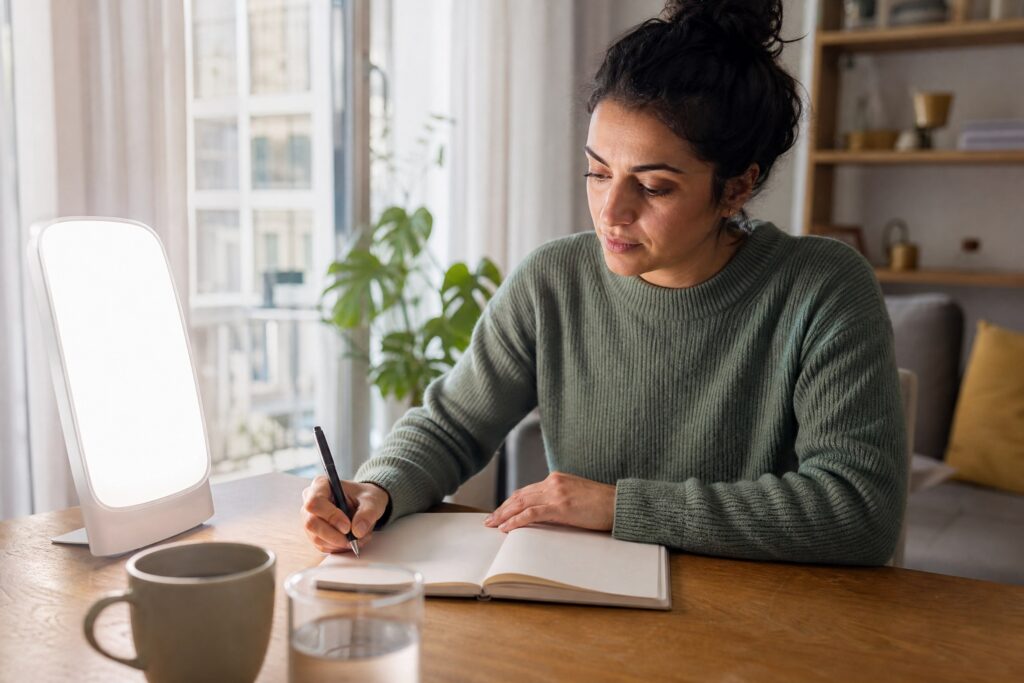
Translating research into plain steps for Emma’s routine:
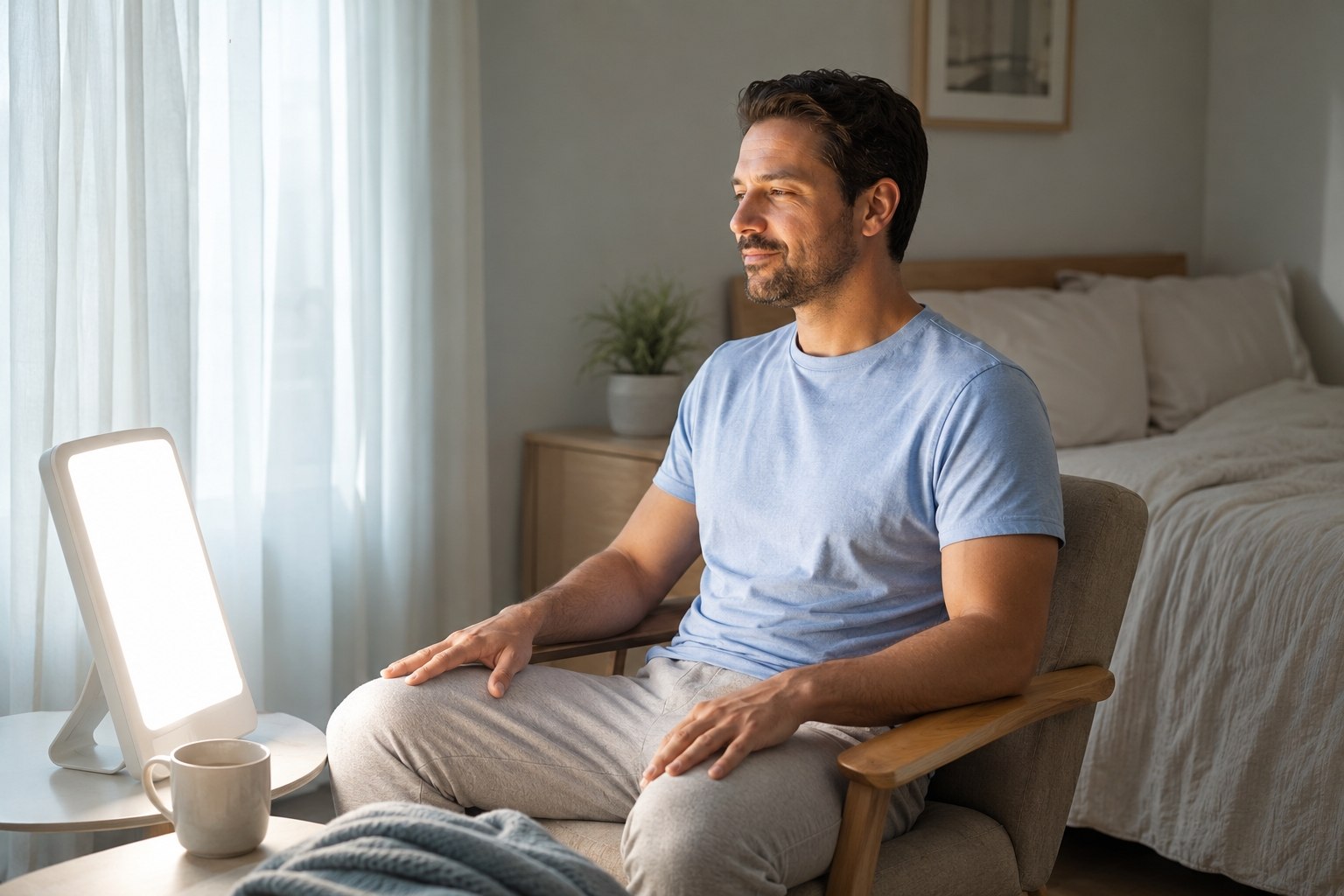
- Start light therapy within 15 minutes of waking. Ideally, sit facing the device so your eyes receive full effect (don’t stare directly, but let light enter your field of view).
- Session length: Bright/blue-enriched lights (circadian): 20–30 minutes at 2,500–10,000 lux. Red/NIR: follow device protocols — most clinical studies use 10–15 minutes, 2–3 times weekly.
- Light intensity & spectrum: Circadian boost with white to blue-enriched full-spectrum (4,600–6,500 K). Red/amber/NIR used for photobiomodulation. Confirm actual spectrum on device spec sheets.
- Frequency: Daily for circadian, 2–3 times per week for photobiomodulation. Set reminders for consistency — the main driver of benefit in every trial.
Most users report feeling more alert and in a better mood within 2–4 weeks, with stronger, measurable changes by 8–12 weeks. For a detailed breakdown of light color choices, see our post on Best Color Light for Sleep.
dawn simulation benefits — what the evidence and device studies imply

Dawn simulation means slowly brightening a lamp to mimic the sunrise — a gentle cue for your circadian system. Trials show that this approach, when scheduled just before your natural wake-up time, can improve both sleep inertia (grogginess on waking) and mood. Unlike photobiomodulation LEDs, dawn simulators focus on gradual spectrum changes and lower brightness first thing in the morning, then peaking after you wake up. Device studies stress that the effect builds over weeks, just like with other protocols. If you need a gentle way to anchor your morning, look for devices specifically marked as “dawn simulation” rather than generic sunrise or “wake-up lights.” For in-depth discussion of spectrum and clinical benefit differences, see Circadian Lighting: A Practical Guide to Better Sleep.
Challenges users report when replicating natural morning light indoors
Real-world feedback reveals some common barriers — often overlooked by marketing:
- Insufficient spectrum or intensity: Cheap devices may lack both the right spectrum (missing blue or too much green/red) and insufficient lux output.
- Improper timing: Using the device too late in the morning or for too short a session blunts the circadian boost.
- Poor directionality/glare: Fixed-position LEDs that emit sharp beams can cause eye strain or headaches. Diffused panels work better for room-filling effect.
- Expectation mismatch: Many users expect instant energy but device studies show benefits accrue over weeks of use.
- Device confusion: Some devices marketed as “circadian” actually use red/NIR LEDs, which do not drive alertness.
- Adverse effects: Rarely, users report eye discomfort or insomnia (especially with blue light at night). Always limit circadian-focused devices to early day use.
| Problem | Root Cause | Fix |
|---|---|---|
| Foggy after light therapy | Session too short/late, wrong spectrum (no blue/white) |
Start within 15 min of waking, increase session to 20–30 min |
| Eye strain or headaches | Glare, wrong angle, ultra-bright LEDs | Use diffused panels, adjust angle, avoid staring directly |
| No effect after 1 week | Unrealistic expectation, inconsistent schedule |
Stick with routine for minimum 2–4 weeks, build steady habit |
| Night sleep disruption | Using bright/blue light after 4PM | Limit all circadian-bright devices to morning only |
How to choose the right indoor device — specs and red flags
Emma and others should not accept vague marketing. Instead, use this clear checklist before buying any light therapy device:
- Spectrum and Wavelength Info: Ask for precise nm ranges. Circadian: blue/white (4,600–6,500 K or explicit blue nm), Photobiomodulation: 590, 630, 660, or 850 nm.
- Lux or Irradiance Ratings: Circadian: needs 2,500–10,000 lux at user distance. Photobiomodulation: look for 20–100 mW/cm² irradiance for home use.
- Session Timer and Programming: Look for timed shut-off plus programmable dawn simulation where possible.
- Clinical Evidence: Ask for device studies or published protocol — not just “similar to clinical” claims.
- Manufacturer Transparency: Names, specs, and guarantees listed up front. Contact info visible.
- Safety Certifications: CE, FDA, or local standards for home medical devices.
For a deeper dive on lux and choosing certified bright-light boxes, don’t miss our 10,000 Lux Light Therapy Guide. For spectrum/CRI advice, see Which Color Metric Matters (CRI, TLCI, SSI).
Troubleshooting common side effects and limitations
- Eye discomfort: Step back from the lamp, use a diffused panel, and check angle so you’re not staring at a pinpoint beam. If symptoms persist, stop and consult an eye doctor.
- Poor sleep: Move all blue-enriched or high-brightness sessions to before noon. Use red/amber only at night.
- Slow progress: Trust the data — most benefit appears after several weeks. Avoid switching devices too soon.
- Device confusion: Match your goal to the light type: circadian for morning energy, photobiomodulation for tissue/supplemental support.
Safety reviews and expert consensus (example review) prove that the right spectrum and slow ramp-up reduce side effects. If in doubt, check manufacturer claims against published specs and consult medical professionals for pre-existing eye or skin conditions. If insomnia or mood disturbance worsens, pause the protocol and seek advice.
2-week, 6-week and 12-week morning routines (sample plans)
Here’s how a progressive, research-aligned morning light therapy plan looks:
- First 2 weeks (initiation):
- Bright/circadian light: 20–30 min, daily after waking.
- Optional: 10–12 min red or amber LED, twice per week for tissue benefit.
- Note your mood, energy, and sleep after week 1 and week 2.
- 6 weeks (consistency):
- Continue previous routine. Add light movement or calming ritual with light as a cue.
- Combine with dawn simulation if you struggle with early wake-ups.
- 12 weeks (maintenance):
- Expect to notice clearer, more measurable effects (see energy charting for tracking mood and AM alertness).
- At this point, you can test whether reducing sessions maintains benefits, or if you need a continuous cycle each work week.
Users should expect an initial natural light morning routine benefit after 2–4 weeks and greater circadian morning boost effects by 8–12 weeks, according to device trial timelines. For a detailed reset plan, see How to Fix Your Circadian Rhythm: 14-Day Proven Reset Plan.
What competitor articles overlook
Most top-ranked content makes several critical errors:
- Mixing up circadian and photobiomodulation: They treat red/NIR LED trials (skin/tissue) as if they prove circadian benefits — they don’t.
- No device spec guidance: Little or no info on exact wavelength, lux/mW, or session length — this leads to wasted purchases.
- Poor timeline clarity: Promises of “quick fixes,” but the literature shows real benefits take weeks to months.
- Safety and clinical credibility ignored: Many guides overlook the consensus on spectrum, duration, and dosing from clinical sources (see AAD 2024 and dermatology reviews).
Choose routines and gadgets based on actual trial specs, not influencer buzz. For expert coverage of smart circadian automation, check out our Alexa routines guide (4 Proven Alexa Routines for Circadian Lighting).
Sources & further reading
- 2023 clinical study (Red LED, 630 ±10 nm, 12 min/twice weekly, 3 months)
- Split-face red/amber LED wrinkle study (PMID: 36780572)
- Photobiomodulation CME, J Am Acad Dermatol (2024)
- AAD Guidance on Light Therapy Devices (2024)
For more on spectrum and dawn simulation, see our deep-dive on Best Color Light for Sleep: Why Red and Amber Work and our Philips Hue Circadian Bulbs Guide.
FAQ
How soon will I feel more energy with indoor morning light therapy?
Most research shows initial changes in energy and mood after 2–4 weeks of daily or regular use. Consistency matters; expect measurable results by 8–12 weeks.
Is morning light therapy safe for my eyes and skin?
When you follow device and clinical study guidelines (intensity, spectrum, timing), safety reviews suggest very low risk. Avoid prolonged exposure to high-intensity blue light and never use circadian-light devices after midday.
Can I use red light therapy instead of a bright light box for energy?
No. Red and NIR LEDs primarily provide tissue and skin benefits, not circadian alertness. For energy, focus on blue-enriched or full-spectrum bright light in the morning.
What if I work nights or shifts?
Adjust your morning light routine so that your first waking hour always includes your light session, even if your “morning” is at night. Automation and scheduling help you stay on track. See our Proven Reset Plan for more.
Do I need to buy expensive smart bulbs?
No. Focus on devices with verified spectrum, lux, and session timers — these do not need to be high-end or “smart.” Check our Buying Guide for affordable, verified recommendations.