
If you’ve searched for natural ways to improve sleep, you’ve probably come across claims that red light therapy can help you fall asleep faster, sleep more deeply, and wake up feeling refreshed. But how much of that is actually supported by research?
The answer is more nuanced than many headlines suggest.
While bright blue-rich light in the evening is well known to interfere with the body’s natural circadian rhythm, the evidence for red light therapy is still developing. Some studies suggest it may support sleep quality or recovery in certain groups, while others show limited or inconsistent benefits. The results often depend on the type of light, the treatment timing, the intensity, and the people being studied.
In this evidence-based guide, you’ll learn what current research actually says about red light therapy and sleep, how it differs from ordinary bedroom lighting, who may benefit the most, and what limitations you should know before investing in a device.
If you’re looking for practical, science-backed advice instead of exaggerated marketing claims, this guide will help you understand where red light therapy shows promise—and where the evidence is still evolving.
Key Takeaways
- Clinical studies through 2024 focus on skin and hair, not direct sleep or melatonin benefits—few sleep-targeted RCTs exist.
- Red and near-infrared light have plausible biological mechanisms for affecting sleep physiology, but benefits for sleep are still theoretical, not proven.
- If you want to try red light sleep therapy, base your approach on device specs and dosing used in skin/hair trials, and set realistic, patient expectations.
- Quick Answer — What the Evidence Currently Supports
- Where the Literature Actually Is (2022–2024): Focus, Quality, and Limits
- Biological Plausibility — Mechanisms That Could Affect Sleep and Melatonin
- What Clinical Studies Used (Wavelengths, Dose, Duration) — Lessons for Sleep Trial Design
- Practical Translation — How to Trial Red/Infrared Light for Sleep
- What Users Most Commonly Complain About or Dislike
- Safety, Side Effects, and Contraindications Relevant to Sleep Users
- Top 3 Scientific or Practical Insights Missing from Current High-Ranking Articles (Actionable Research Gaps)
- Bottom Line and Recommended Next Steps
- Frequently Asked Questions
Quick Answer — What the Evidence Currently Supports
When it comes to does red light therapy help sleep, the evidence today is limited and indirect. Most published clinical work and randomized controlled trials as of 2024 are focused almost entirely on skin (wrinkle reduction) and hair outcomes, not sleep or melatonin regulation. Reviews explicitly state: “Most studies focus on RL, NIR, and amber light with clinical outcome data predominantly for skin” (MDPI review).
There are plausible mechanisms by which red or near-infrared light might influence circadian rhythms or melatonin, but direct, well-powered studies showing red light therapy sleep benefits are lacking. If you’re seeking evidence-based sleep tools, the research gap is clear—most clinical claims rest on extrapolation from skin/hair data, not direct sleep results.
Where the Literature Actually Is (2022–2024): Focus, Quality, and Limits
If you search for red light sleep therapy or infrared light sleep studies, you’ll mostly find reviews and CME updates focused on photobiomodulation as a dermatology treatment. High-quality recent reviews and guidelines (AAD; Maghfour et al., 2024) summarize detailed mechanisms and clinical trials but they all concentrate on skin endpoints like wrinkles, firmness, and hair regrowth.
The MDPI review plainly states: “Most studies focus on RL, NIR, and amber light” with outcome data for dermatologic effects, not for sleep or hormonal endpoints. There remain very few, if any, direct RCTs from 2022–2024 looking at sleep outcomes such as sleep quality, latency, or overnight melatonin profiles following red light interventions.
If you have sleep difficulties, this means that while red LED sleep research is technically possible and biologically plausible, robust human evidence simply isn’t available—yet.
Biological Plausibility — Mechanisms That Could Affect Sleep and Melatonin
Why does red light get talked about for sleep? It comes down to how red and near-infrared light interact with cell biology. These wavelengths (typically 630–850 nm) penetrate tissue, are absorbed by mitochondrial cytochrome c oxidase, and can increase cellular ATP production. This is called photobiomodulation.
Other effects include increases in nitric oxide and local vasodilation. For skin and hair, this boosts circulation and may signal cellular repair. Theoretically, increased ATP could support brain energy needs in sleep regulation, while nitric oxide might support vasodilation and relaxation at bedtime. There are also early suggestions that red light has less tendency than blue light to suppress melatonin in the evening, potentially making it “circadian friendly.” However, these are hypotheses: clinical reviews like Maghfour et al. 2024 and the MDPI review present these as biological rationale, not proven sleep effects.
What Clinical Studies Used (Wavelengths, Dose, Duration) — Lessons for Sleep Trial Design

Because sleep trials are scarce, practitioners look to skin and hair RCTs for device settings and doses. Here’s what quality studies have used:
- Wavelengths: Red light at 630 nm is standard; combining it with 850 nm near-infrared is increasingly common.
- Energy Dose: Doses in dermatology typically range from 10–50 J/cm² per session. A 2023 study used 630 nm at 15.6 J/cm², resulting in a 38% wrinkle depth reduction and 47% increase in dermal density after 12 weeks (study guide).
- Session Timing & Frequency: Most protocols apply light 2–3 times a week for 8–12 weeks, with sessions often lasting 10–20 minutes.
For sleep targets, experts suggest applying light 30–60 minutes before bedtime, repeating several times a week, as a conservative trial protocol. But two key realities: these parameters are inferred, not proven for sleep, and consistent use—not single exposures—matters most according to skin/hair trial results (Cureus product guide).
Practical Translation — How to Trial Red/Infrared Light for Sleep (If Someone Wants to Try)
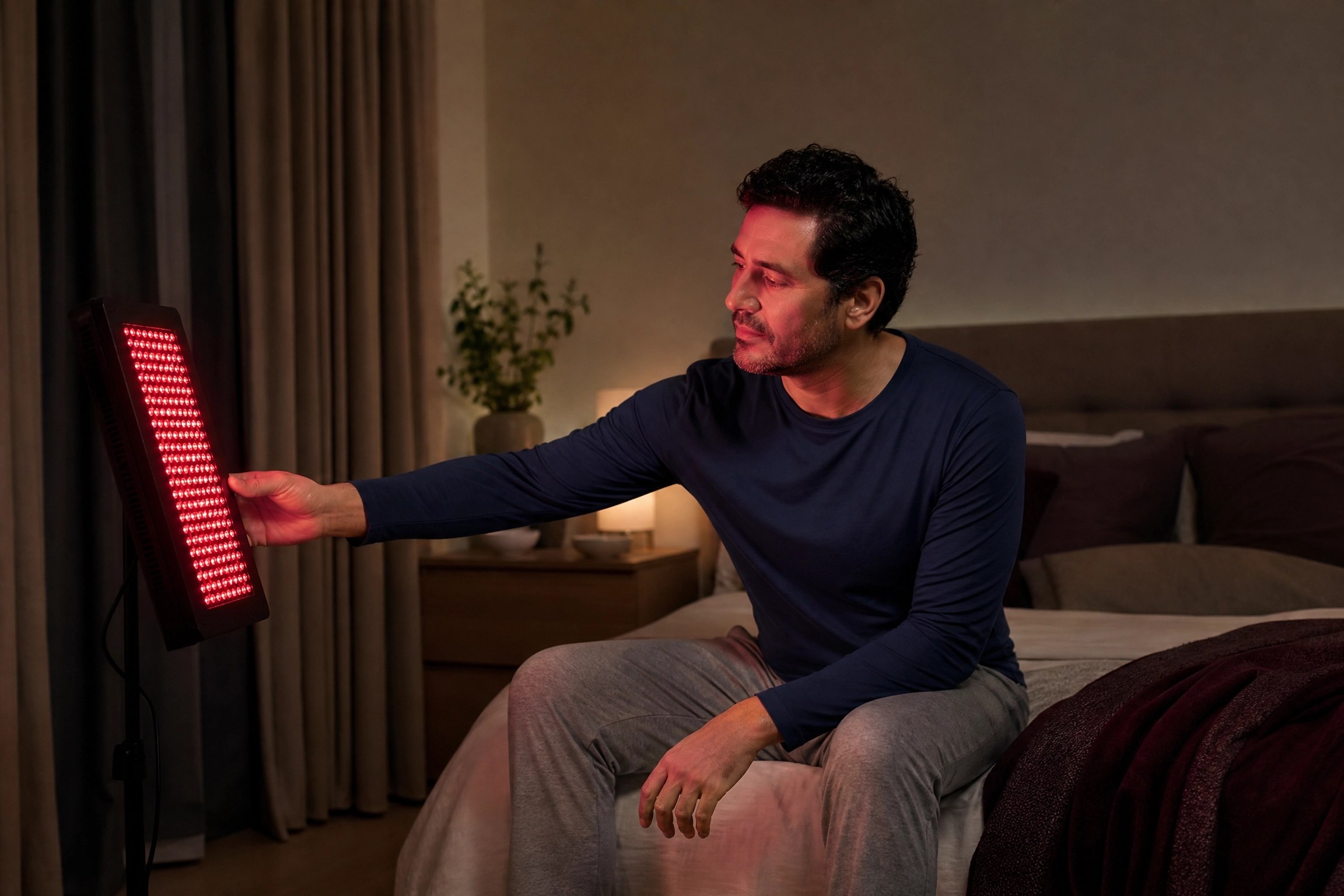
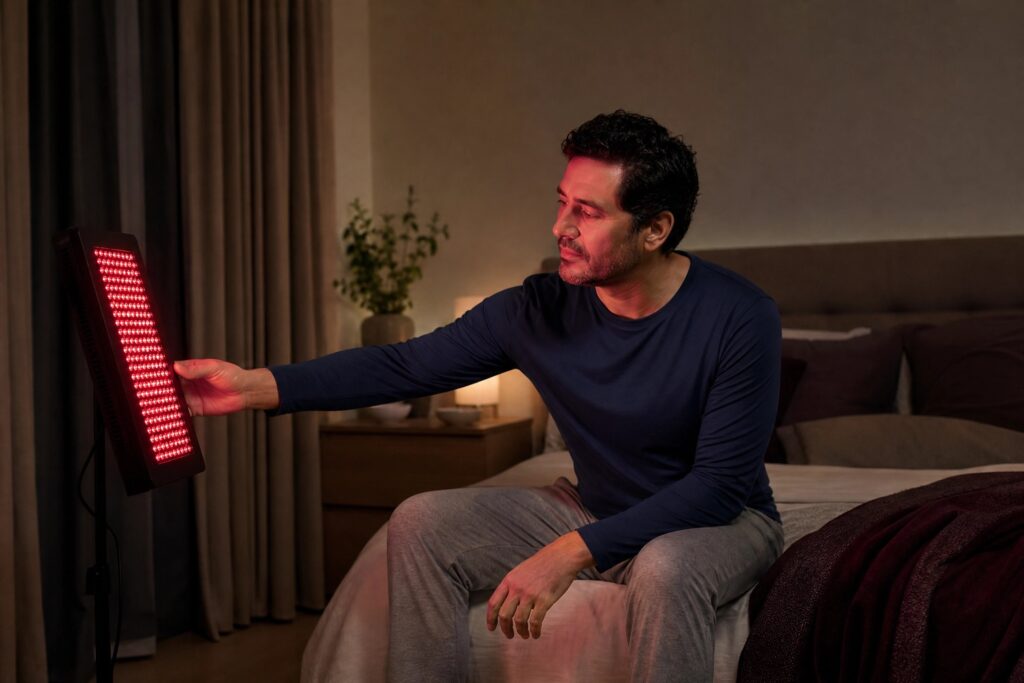
If you choose to trial red light sleep therapy or infrared light sleep, here’s how to do it in an evidence-informed, realistic way:
- Choose a device with specified peak wavelengths—preferably 630–660 nm for red and/or 810–850 nm for NIR. Avoid “red light” bulbs with obscure spectral data.
- Calculate or estimate energy density: Target approximately 10–20 J/cm²/session—mirroring values from skin/hair studies, as a safe conservative starting point.
- Apply the light for about 10–20 minutes, at a comfortable, skin-safe distance. Ideally time the exposure 30–60 minutes before habitual bedtime.
- Repeat at least 3–5 nights per week, for 2–4 weeks. track your sleep with a sleep diary or actigraphy.
- Use proper eye protection (especially with NIR), and monitor for skin heat or irritation.
In short: Select a device with known 630–660 nm (red) or 810–850 nm (NIR) output, start at low exposures, use before bedtime for 2–4 weeks, and track your sleep.
For more on circadian-friendly lighting, see our proven color light for sleep guide and tips for setting up Alexa-based circadian routines.
What Users Most Commonly Complain About or Dislike
Users hoping for red LED sleep improvements often hit several frustrations, especially when expectations are fueled by marketing, not clinical endpoints. Here’s what the research and consumer product guides report:
| Common Complaint | Practical Example | Underlying Cause |
|---|---|---|
| Inconsistent results | One user reports sleep improvement, another none | No standardized dosing, lack of sleep-specific studies |
| Device variability | Unclear specs, fake “red light” lamps on the market | Low-quality or unverified hardware, unreliable irradiance |
| Slow or absent benefits | No change after a few nights; disappointment | Clinical data shows changes in skin/hair occur gradually, not acutely |
| Burden of repeated sessions | Annoying to use nightly, especially without clear benefit | Protocols require consistent, prolonged use for results |
| Lack of sleep-specific evidence | Confusion about why devices are marketed for sleep | Research gap; most RCTs target skin but not sleep endpoints |
Buyer guides and clinical-practice summaries, like the Cleveland Clinic overview, echo these practical obstacles—a reality that matters when setting your expectations. If you’re curious about how red/NIR therapy compares to bright light for true circadian effect, see our 10,000 lux light therapy guide.
Safety, Side Effects, and Contraindications Relevant to Sleep Users
Red light sleep therapy and near-infrared devices are generally low-risk when used as directed, especially compared to blue or bright light exposures. However, dermatology trials and product guides do highlight several cautions:
- Never shine devices directly into the eyes: serious risk with powerful NIR LEDs.
- Watch for skin irritation, especially if you have photosensitizing conditions or are on medications that increase light sensitivity.
- If you are pregnant, on photosensitizing drugs, or have active skin conditions, always consult a clinician before use.
- High heat or prolonged sessions (well above the 10–20 min, 10–20 J/cm² range) are not recommended.
- Unrealistic expectations—these are not “sleep cures” and effects, if any, are likely modest.
Professional summaries and reviews (AAD guidance, J Am Acad Dermatol 2024) consistently rate RL/NIR therapy as safe for dermatology endpoints when used properly.
For more on circadian safety, see our guide on blue light and sleep.
Top 3 Scientific or Practical Insights Missing from Current High-Ranking Articles (Actionable Research Gaps)
- Lack of direct, well-powered RCTs on sleep/melatonin: Current reviews (MDPI; J Am Acad Dermatol 2024) plainly admit: “Most studies focus on RL, NIR, and amber light” for skin endpoints. There’s a real need for large, well-designed sleep-specific trials testing red and NIR light on latency, sleep quality, and on overnight melatonin secretion.
- Unstandardized dosing for sleep: Guidelines for J/cm² dose, therapeutic irradiance, and exposure duration are all derived from skin protocols or marketing—there’s no consensus for sleep. This leads to user confusion and wasted effort.
- No clear guidance on timing: When exactly should red light be applied relative to dim-light melatonin onset (DLMO) or habitual bedtime? And how does it interact with ambient blue or white light exposure? These circadian timing questions are unaddressed in nearly all popular sleep-light articles.
For in-depth practical circadian lighting fixes, explore our circadian lighting guide.
Bottom Line and Recommended Next Steps for Readers and Researchers
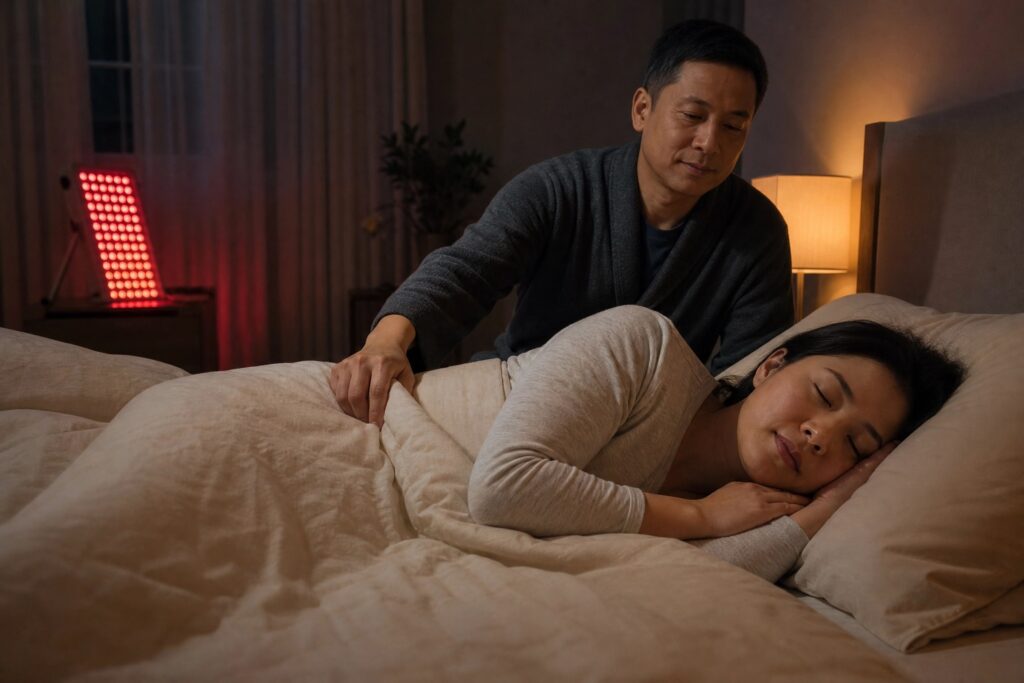
The upshot: There is a credible biological rationale—confirmed in clinical photobiomodulation and skin/hair trials—for the safety and cellular effects of red light and infrared therapy. But through 2022–2024, the evidence for sleep or melatonin improvement is not robust; there is a visible gap in published sleep-targeted RCTs.
If you’re a consumer, a cautious self-experiment using standardized devices and dosing may be reasonable, providing you track sleep and accept that any benefit will likely be modest and take time. For clinical researchers, the priority is clear: design and run high-quality sleep and melatonin endpoint RCTs using device parameters drawn from credible RL/NIR trials (such as 630 nm and 850 nm; 10–20 J/cm²; regular, pre-bedtime sessions).
It’s smart to revisit your sleep environment with circadian-friendly bulbs, leverage automated routines via Alexa for better sleep, and only trial red light with realistic, well-informed expectations. Remember to regularly ask: does red light therapy help sleep—and demand new, direct evidence.
Frequently Asked Questions
Is red light therapy proven to help you fall asleep faster?
No. There are plausible mechanisms based on photobiomodulation, but as of 2024, no high-quality, sleep-targeted RCTs have shown significant improvements in sleep onset with red light therapy. Most research is on skin and hair outcomes.
How does red light therapy compare to blue light or bright light for sleep?
Red and near-infrared light do not suppress melatonin like blue or bright white light and may be less likely to disrupt sleep. However, their positive effects on sleep are still theoretical. For clinically proven light therapy, see bright light box comparisons in our lux guide.
What are safe starting device parameters for red light sleep trials?
Look for devices with 630–660 nm (red) and/or 810–850 nm (NIR) output. Try 10–20 minutes per session, targeting about 10–20 J/cm², ideally 30–60 min before bedtime, repeated for at least 2–4 weeks. Always wear eye protection and consult a professional for health conditions.
Should I expect quick results from red LED sleep therapy?
No. All available clinical data (from skin/hair studies) suggest benefits, when present, appear gradually after weeks of consistent use. Immediate “sleep tonight” results are unlikely.
Are there any people who should not use red/infrared light for sleep?
Consult your healthcare provider if you are pregnant, on photosensitizing drugs, or have active dermatologic or sensitive skin conditions. Never shine these devices directly into eyes.